


My role
I designed and structured financing journeys for the new digital bank. To do this, I studied how Sharia principles shaped financial products, defined which terms could be used in the interface, and translated complex rules into clear user flows. I also contributed to the new visual direction, helping the product feel modern, transparent, and trustworthy
Context and task
Zaman Bank started as a traditional bank, but later went through a large-scale digital transformation and became the first digital Islamic neobank in Kazakhstan
After this transformation, the product needed a global redesign that would reflect its new positioning: a modern digital bank built around Islamic finance principles and approved by Sharia standards
The challenge was not only to make the bank look modern. We also needed to explain what made Zaman different from a traditional bank, while maintaining a sense of trust and reliability


Problem
The main problem was trust. Users were already familiar with traditional banks, but a digital Islamic neobank was a newer and less obvious concept for many people
One of the key challenges was explaining how Zaman differed from traditional banks while maintaining the same level of trust and credibility
This affected both the interface and the content. Common banking patterns and wording could not always be used directly, especially in credit scenarios. We had to be careful with how the product described money, profit, obligations, and financial relationships

Solution and final design
The redesign combined three ideas: a visual identity rooted in Kazakhstan, transparent financing journeys, and guidance for users who were new to Islamic banking
We built the visual direction around two concepts:
Kazakhstan’s natural landscape: local photography, warm earth tones, open space, and soft gradients gave the product a grounded and recognizable identity
Transparency: glass-like surfaces, clear hierarchy, and lightweight interface elements reflected the ideas of openness and clarity
Together, these principles helped the bank feel modern without becoming overly corporate or decorative


Translating Sharia principles into product rules
Designing the financing journeys required more than replacing conventional banking terms. The structure of the product had to reflect a different financial model
No interest-based language: instead of focusing on an interest rate, the interface explained the bank’s profit and the total amount the customer would pay
A real asset behind the financing: the journey showed what was being purchased and clarified the bank’s role in the transaction
Terms agreed in advance: the asset price, bank profit, total payment, schedule, and customer obligations were shown before confirmation
No unclear or hidden terms: important conditions and edge cases could not be buried in legal copy or revealed late in the journey
Clear financial relationships: the content explained who owned the asset at each stage and what each party was responsible for
These principles shaped both the interface structure and the wording used throughout the financing journey

Building shared understanding inside the team
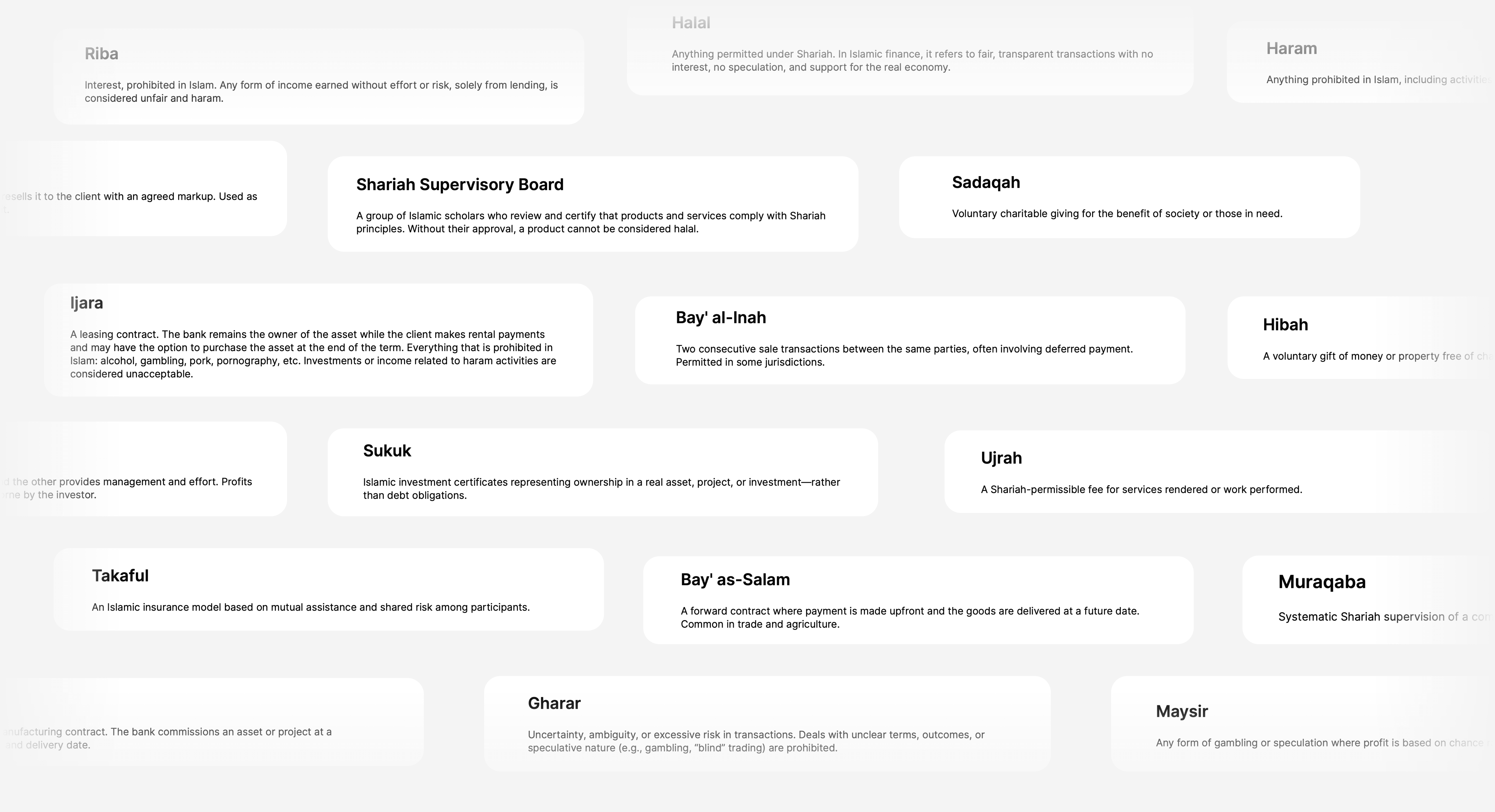
Islamic finance was a new domain for many people joining the project. To help designers, writers, and product teams work from the same principles, we created an internal glossary and onboarding guide
It covered:
Key Islamic finance concepts and their meaning;
Differences from conventional banking models;
Approved terminology and wording to avoid;
Examples from real financing journeys;
The cultural and ethical values behind product decisions.
The guide helped new contributors understand not only the terminology, but also the reasoning behind the product. It gave the team a shared reference point and reduced the risk of falling back on familiar patterns from conventional banking that did not follow Sharia principles
Key improvements
The redesign helped Zaman present a new identity while maintaining users' trust. The product presented a more modern image without losing the credibility expected from a bank
The Sharia-compliant credit logic and careful wording helped avoid misleading or inappropriate financial communication. Rather than adapting conventional banking language, the product was built around Islamic finance terminology and principles
The glossary also reduced the entry barrier for users who were new to Islamic banking. It helped users become familiar with Islamic finance terminology and better understand the product
Results
The redesigned product launched as Kazakhstan’s first digital Islamic neobank, combining a new visual identity with financing journeys built around Sharia principles
5 out of 6 users completed the financing journey
During usability testing, five participants completed the end-to-end application without assistance
6 core financing journeys aligned
The main financing scenarios were reviewed against the bank’s Sharia requirements, including their structure, terminology, and presentation of financial conditions
1 week → 3 days of team onboarding
The internal glossary and onboarding guide helped new designers and product team members understand the terminology, cultural context, and product principles faster
Method: usability testing with six participants before and after revising the journey structure
and content
Team onboarding time compares the process before and after the internal glossary
and onboarding guide were introduced
